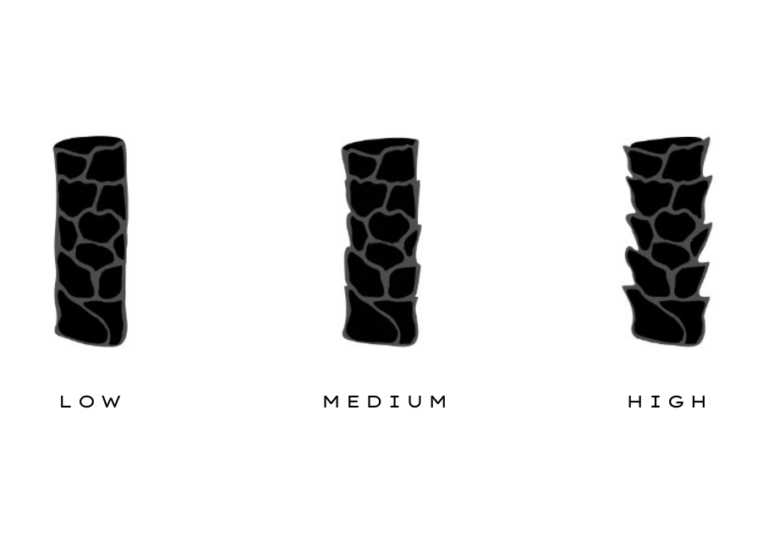
Determining hair porosity allows you to classify your hair, select the appropriate active ingredients and tailor a personalised hair care plan. Hair is divided into root and shaft. The root is located in the hair follicle and together with it forms the bulb (hair bulb). The stem consists of: core (innermost layer),cortex (made of keratinocytes),and a thin casing (outermost layer). The cortex and the integument are composed of scale-like cells. These cells protrude from the hair shaft to a greater or lesser extent and the degree of this deviation determines the porosity of the hair. The degree of hair porosity is the degree of deviation of the outer layer of the hair from the inner layer. There are three types of hair porosity:low porosity,medium porosity,highly porosity. Hair porosity is not a constant feature, it changes depending on hair care, internal factors of the body and external elements. Low porosity hairthey are characterised by the smallest degree of deviation of the cuticles from the hair cortex.– smooth, soft and shiny hair;– they do not frizz and rarely electrify;– resistant to mechanical damage, styling and external factors;– they release moisture slowly, so they dry slowly;– they are easy to weigh down, often lack volume and do not like extensive care. Medium porosity hairThey are characterised by a slight degree of deviation of the cuticles from the hair cortex.They are a combination of low porosity and high porosity hair. They are the most common type of hair.– delicate, thin, sensitive hair;– they tend to become loose and electrified;– susceptible to mechanical damage, styling and external factors;– when combing, they can cause problems, they often crumble and break;– it is easy to deteriorate their condition and appearance. High porosity hair are characterised by the greatest degree of deviation of the cuticles from the hair cortex.– rough, dry, dull hair;– they tend to crumble, break, split ends, become loose and electrified;– susceptible to mechanical damage, styling and external factors;– they dry very quickly, get tangled and are difficult to comb,– they often wave and curly. The frequency, amount and selection of active ingredients should always be an individual matter, adjusted to the porosity of the hair. Proteins and amino acidsrebuild, regenerate and reconstruct the hair structure. Emollientscreate a protective layer on the hair, protect it against water loss and the harmful effects of external factors. Humectantsmoisturise, bind and retain water in the hair structure. Regardless of hair porosity, each care should be based on:– thorough hair cleansing,– exfoliation of the scalp,– moisturising and protection,– reconstruction, regeneration, filling in gaps,– gentle treatment.